Related Articles


 Related Articles


International President Edwin D. Hills Keynote Address October/November 2001 IBEW Journal
But before I say a single word about the present times and the future of this great Brotherhood of ours, allow me to speak from the heart for just a moment. I wish all of you could see this convention from my perspective, here on this platform. I can tell you with the utmost sincerity that in this room and across this vast North American continent, the IBEW is alive and well. Many of you are involved in leadership positions in all parts of the trade union movement, not just in the IBEW. But for those of you who give much of your lives to the labor movement, allow me to say thank you, thank you for giving me the opportunity to lead such a devoted and sincere group of men and women. This convention, this great gathering of the IBEW, is the fountain of our democracy, the highest governing body of our union. Were here to do the business of our union and to fulfill our fundamental mission as leaders of this great Brotherhood to which we all owe so much. And how do we best define our mission? It goes by many names. The working man. The average Jane. Joe six-pack. The little guy. The working stiff. Rosie the Riveter. Call him or her by any name you want, it all comes down to a fight for the rights of working men and women in the United States and Canada and, indeed, all around the world. Thats what were fighting for. Thats what drives us to do what we do. And that, brothers and sisters, is what brings us here to San Francisco. A business may have a bottom line. A nonprofit organization might have a specific legislative objective. A charity might have a fund-raising target. An association may have an ongoing mandate to protect their special interests. But a trade union, there is no limit to its work. Our task is eternal, our mission never totally accomplished. Dignity, equality and social justice are never final and never secure. We must fight to win them, fight to protect them and fight to expand them. We knew that when we signed on as IBEW leaders and activists, just as our founders did when they lit the spark of the IBEW in 1891. We know it still, ten years into our second century as a Brotherhood. We know it now at the start of a new century and a new millennium. And it will be reinforced when we light the new IBEW Beacon that will shine the way to the bridge to opportunity. This beacon will shine over Chicago as a testament to the IBEWs dedication to the future and to the future of all working men and women. This union of ours has weathered 110 years of history. We have achieved much. We have suffered much. But, most of all, we have served as the bridge to opportunity for countless thousands of members, spouses, relatives, neighbors, and untold numbers of men and women who have crossed over from poverty and uncertainty to the shores of a decent standard of living because of the International Brotherhood of Electrical Workers. As we gather in this city thats the site of two of the most astounding bridges ever built by the hand of man, we take their image as our theme for this 36th International Convention. We, as part of the IBEW, are here today to make sure that that bridge to opportunity remains strong, proud and able to withstand the winds of change, as well as the treachery of our enemies. In a convention keynote speech, the temptation exists to recite a laundry list of tasks to touch on and issues carefully selected to appeal to the various branches within our Brotherhood. Now, theres no doubt that specific goals are important, and we will, in fact, be dealing with the details affecting each and every branch and operation within our union as part of our business at this convention. But, we owe it to ourselves and we owe it to our members and we owe it to future generations of IBEW sisters and brothers to lift our heads higher at this, our first convention of the 21st century. We need to tap into our wisdom and experience in order to take a hard look at the big picture as we forge our place in the future. And hammer out our own place, we must do. Those of us who came of age in the 1950s and 1960s were ill prepared for the change in fortune that our union and all of organized labor experienced in the decades that followed. Our first reaction was to damn our luck and hope for the good times to return. Now, I think it was a baseball manager who once said, "Luck is the residue of design." And it was not until we took responsibility for our own future and took charge of our own fate that we started on the road back. The perspective of our 110-year history shows that waiting for good times is not a pastime with a whole lot of success. In fact, since 1891, times have more often been bad than good for organized labor. As people seeking to speak for the worker and uniting to exercise our power, we are not and we have never been popular with the powers that be. Nor has our message of changing the status quo been welcome by working people themselves. Yet we survived, we grow and we continue to be the bridge to opportunity. Since the IBEW celebrated its centennial in 1991, there have been many of our oldest and most established local unions who have also marked their 100th anniversaries. Each of these celebrations has given many of our members a fresh appreciation of the tremendous odds that the pioneers of the IBEW faced. Their enemies, like our enemies today, had wealth, privilege and a compliant legislative process and the power of the media at their disposal. But our founders had courage and an age-old longing for something better and a chance to share in the wealth created by their labor, a better life for their families and for a bridge to opportunity. The fact that our organization is still here, still strong and proud and able to gather in this great city in this great hall today, is a testament to the essential justice of our cause and the strength of the human will. Those corporate empires, once thought invincible, are disappearing as global capitalism consumes itself. Yet, were still here. We did not survive by waiting for good times. We persevered and prospered by putting into action the time-tested values of solidarity, organizing and self reliance. Brothers and sisters, I submit that we need those values now more than ever to create the kind of future we want for our families, ourselves and future generations of IBEW members. So, how do we go about our mission? How do we put our values into practice to keep that bridge of opportunity open? We must start by protecting collective bargaining. It sounds simple. We have had long-lasting bargaining relationships with so many employers in so many industries that its easy to take the process for granted. Some of our working partners from the industries we represent are with us at this convention, and were happy that theyre here. But make no mistake about it, there are forces out there that seek to destroy our right to bargain. And, if they succeed, they will squeeze those enlightened employers and force them into the same kind of no-win, low-wage competition that presently afflicts the North American trade policy. The greatest single instrument for human dignity in the modern world is the collective bargaining agreement. It is the embodiment of decency, its the guarantor of justice in the workplace. The union contract knows no divisions of race, class, creed or color. It opens the doors of opportunity for all. Protecting it must be our highest priority. Now, this is an issue that cuts across industry lines. It is of foremost concern in utilities, where restructuring has changed the rules of the game, as companies sell off generation and transmission, and conglomerates are growing in size, huge, with leverage enough to gobble up these assets. Witness what has taken place here in the Bay Area. Pacific Gas & Electric, once the largest investor-owned utility in North America, stands today in bankruptcy, thanks to the deregulation of the market and the greedy profiteering of generating companies, among them Enron and other Texas-based friends of the Bush/Cheney Administration. It has all been well documented. We have been fortunate enough to preserve the collective bargaining agreement at PG&E during the bankruptcy. But, you know, we cannot always count on doing the same the next time deregulation drives one of our represented companies into a financial abyss. Look also at the fight being played out in Illinois where members of Local Union 15 employed by Midwest Generation have been engaged in a bitter struggle to win a fair contract. The former units of Commonwealth Edison are now part of an energy conglomerate composed of some of the most antiunion players in the industry. To make matters worse, Midwest Generation has retained the services of none other than the Burke Group, that notorious consulting firm who helped originate the practice of union-busting that has done so much to harm the workers in the United States and Canada. This is a clear signal that the company wants our union out. Theyve drawn a blueprint for their future, and were not in it. Take this scenario and play it out across the country. Understand that companies like PECO from Philadelphia and Duke Power and BG&E are partnering with others as the industry restructures. More often than not, the antiunion sentiments of these and other predators destroy the constructive and cooperative instincts of other utilities. And you can be sure there are other changes coming in the utility industry that have yet to be seen. Put it all together and we see that our long-term presence in this key industry cannot be taken for granted. Now, lets take a little look at telecommunications. Last year, our locals at Verizon weathered a 15-day strike and emerged with a solid contract. But since then, the picture has not been so rosy. While our agreements for the core business at the regional companies remain strong, our efforts to grow in the rapidly expanding segments of the industry, such as broadband and wireless, have been met with tremendous resistance. Youll notice the black-covered booth in the Expo. We were approached by AT&T after they spun off their portion of wireless and asked to put a booth there. We asked them very succinctly and very seriously to honor their commitment for card check and for a kind of neutrality agreement that they wouldnt beat us up too badly when we tried to organize. After many conversations, many meetings, I called the gentleman and he said, "Well, well get back to you." I said, "If you dont, you are not welcome at our Expo." All the words in the world that they triedtheyd say, well, we can do this and we can do that, but it was very important to me that we not put a booth there; so, hence, the black draped one. I hope they get the message. I hope we can talk to them in the future. Because we cannot maintain a strong collective bargaining presence in telecommunications if we have a presence in only one sector. No matter how strong we may be in that core business, we will be increasingly isolated if we do not expand our reach and organize and negotiate for workers in the other growing divisions. In the manufacturing branch, one would be pretty hard pressed to find a growth area. While we still have some 94,000 members working under 727 collective bargaining agreements, collective bargaining is being eroded in the whole industry. Lucent, once the crown jewel of our manufacturing branch with its promise of high-tech and high-skill employment, has been broken into several pieces. Lucent made the basic decision that they didnt want to be involved in manufacturing anymore. While many of our members are holding their own working for the new companies of Agere and Avaya, the sale and the closure of other plants has cut many from our rolls. Likewise, our members in consumer electronics continue to feel the pinch of NAFTA and other economic conditions that are driving jobs overseas. So, where do we go from here? Are we intimidated by the challenges staring us in the face? Will the negative forces overcome the positive work of the IBEW and all of organized labor? The answer has always been NO. The answer is presently NO, and the answer always will be [Delegates shouted "NO."] Thank you. As I said, this is nothing new. Weve always had powerful enemies and always had challenges. Weve always done our utmost to protect each and every member that belongs to the Brotherhood. Now, if youd bear with me for just a moment. Come with me, I would like you to do something for me. Open your three-ring binder, please. Open it up. Come on. I would like you to look at the inside of the back cover of your convention material. Is it open? Clear in the back. There youll see a name. See it? That name, brothers and sisters, is the name of a member for whom you are responsible, figuratively speaking. His or her livelihood and the well-being of his or her family rests squarely on your shoulders and the action that you take as an individual union member. Your protection of the collective bargaining process and the existence of the trade union movement will have a profound effect on the lifestyle of that person as well as your own. No, weve never been able to ensure that everyones job is safe. We probably never will be. That is why we stress solidarity. That is why we stress the fact that we are, in fact, our brothers keeper. That is why we help each other in bad times and consolidate our strength in good times, because, brothers and sisters, that is our job, that is our calling, that is what we signed on to do. So lets get about doing it and doing it right. Like all skilled workers, we know that you can
never stop learning. As we sharpen our skills as tradesmen and To use a popular expression of the day, were here at this convention to talk the talk. But when we return to our day-to-day responsibilities, we must walk the walk. If I had a laundry list of answers, Id read them now. If I were a magician, Id wave my wand and do whatever they do and make everything better. But we gave up believing in fairy tales a long time ago. We need solid, concrete action at every level to keep the traffic flowing on all lanes of the bridge to opportunity. How we do that will be decided in many places throughout Canada and the United States. In meetings, negotiations, public forums, anywhere the interests of the IBEW members are at stake, we will be there doing what needs to be done in each situation. But here, as delegates to this convention, we need to consider elements of a grand strategy that will help us protect our members and the right to collective bargaining across the breadth and the scope of the IBEW. One topic that Ive always considered vital is to master technology. You know, electricity itself was on the cutting edge of technology at the end of the 19th century. It still is, especially as we use power to power the explosion of the communications technology thats shaping the world around us today. This technology, which we refer to as voice/data/video, is already having a tremendous impact on the inside construction branch. You know, at first we saw it as an extension of the inside wiremans work. We were wrong. It is an entirely separate category requiring an entirely different set of skills. Presently we have a committee of vice presidents who are working on an agreement that will shape our future in voice/data/video. It will create a separate workforce withinwithinthe inside branch. We cannot afford to wait until all of our existing journeymen have been cross-trained in this work and our apprenticeship programs have been fully established. Now, I say this knowing that many inside locals have done a remarkable job in a very short time of preparing to train and win this work. But we must now begin to organize those who are already out there doing it. If we wait until we are totally ready, we will be eating the dust of those who are out there going after the work right now as we speak. Those who have attended our construction conferences and our joint NECA-IBEW voice/data/video conference have heard me say that the train is leaving the station. Well, brothers and sisters, it pulled out; but its still in view, maybe only through the eye of an eagle, but still in view nonetheless. There may be still time to catch it. But there is absolutely no time to dally on the dang platform. Theres no way to sugarcoat this issue. Were talking about a major change in one of our core occupational categories. Like all important changes, it will not always be smooth and it will not make everyone comfortable. But the time has come for us to recommit ourselves to the future of our proud trade by deed as well as by word. Our very future is at stake and we are not going to go down in the IBEW history as the generation that lost the future. The future has always been ours. You and I are not going to be the ones to allow it to be taken from us; and we certainly are not going to lose it through our own shortsightedness. That is my solemn pledge, and I make it here to all of you today. The debate on whether to organize was settled years ago, or so we thought. President J. Scott Milne in 1954, at our 24th International Convention, said, and I quote, "We must organize and organize and organize some more. Whenever there is an electrical worker in any branch of our industry who has no union protection, we must bring him into our Brotherhood, giving him the same strengths and benefits that we enjoy." President Gordon Freeman at the 27th International Convention in 1962 said, and I quote, "What else must we do if we are to move forward in the electrical era? We are going to have to organize in spite of the opposition encountered. We are going to have to make better union members out of the members that we have. And we are going to have to have more regard one for the other." In 1966, President Freeman quoted from the forward of our first Constitution saying, and I quote, "We earnestly invite all belonging to our trade to come forward, join our ranks, and we know of no other means to accomplish this than by organizing." At that time, he said that there were as many as a million outside the labor movement, and he challenged us in 1966, you and I, many in this room, to go after them and bring them into our Brotherhood where they belong. President Charles Pillard stated at the 29th International Convention in 1970, "The IBEW must continue to organize electrical workers under the banner of the IBEW. Organizing is a basic objective of a union. Organizing is an ever-continuing operation of this and any other union. We must either organize or cease to exist." Charles Pillard, again at the 30th Convention in 1974, further stated, "You know, if we dont organize the unorganized and train and retrain our members, well lose control of the electrical industry that is rightfully ours." At the 1978 and 1982 conventions, President Pillard continued to encourage organizing as an integral part of our existence. A lot of you will remember this. In 1986, at our 33rd Convention, President Emeritus Barry, while discussing the goals of the founders of our great International Union, said, "The growth and progress of this Brotherhood has probably succeeded beyond any dreams that they, our founders, may have envisioned. "However," he went on to say, "their ultimate goal to organize all electrical workers has yet to be attained." Now, as we assemble in this great hall, we all know, as stated at every convention, that this issue of organizing is a primary goal of this Brotherhood. Brothers and sisters, I submit to you that for the most part, we have failed. Weve failed to protect our own future, let alone the future of those who will come after us. There may be some in this great gathering of union leaders that do not believe in organizing. Well, brothers and sisters, organizing is the job of every local union, to protect the IBEWs jurisdiction. Should you choose not to organize the jurisdiction with which you have been entrusted, I will send someone to your local union to assist you. But I should also mention that it will be at your expense, your local unions expense. All you need to do is request it. All you need to do is ask. Or should you not request any assistance and absent that request, you will have failed to fulfill the obligation that you agreed to when you took your oath of office. The strategy on how we organize has been shifting constantly, and our record in organizing in the inside branch has been a model for other unions to follow. But its not enough. We are still keeping those who are qualified out of our ranks, and theyre gaining in strength. We must bring them into our ranks, and we must teach them, teach those who are in need of additional training. We have begun an aggressive and ambitious campaign in the outside branch that has already begun to bear fruit. Were restructuring our Railroad Department and hope for a revitalization of this branch to include an all-out organizing drive. Were increasing our efforts in broadcasting and related industries that will affect our members in that branch of our Brotherhood. The right to organize, free from employer interference, has been a major focus of collective bargaining in the telecommunications industry. Were now fighting to make employers who agreed to certain things live up to those clauses that they agreed to. Witness the booth in the Expo. The changing utility industry offers numerous targets, new targets to organize. The same is true for railroads and broadcasting and among the government workforce. Over the next five years, we will build a much stronger record across the board in organizing if we are to continue to build a bright future. Now, contrary to what the naysayers would have you believe, were not in dying industries. All of our industries are changing and evolving into something different. But theres no shortage of targets out there, not a shortage at all. There is no lack of jobsites crying out for union representation. And there is no end to the need for all of our members, every one in this hall, to step up to the plate and take their share of responsibility for organizing. Now, if the labor movement means anything, if rank-and-file participation is to be real, then we must light the fire of organizing all across the United States and Canada, up in Alaska and across the Pacific to Hawaii, the Island Territories and down to Puerto Rico. Organizing goes hand in hand with our effectiveness in the public arena. A well organized union is one that can make its voice heard and can legitimately claim to speak for the majority of workers in the industry. Organizings twin sister is mobilization for action, especially in the public and the political arena. You know, I think its time that we evaluate the strengths and the weaknesses of our political/legislative program. And we rank as one of the most respected organizations, not just among unions, but among any organization in our nations capitals and our state and provincial legislatures. Our Political Action Committee is among the strongest on this continent, and in the past two election cycles, we have shown that we are rediscovering our touch at grassroots communication and mobilization. But there is room for improvement. You know, I was deeply concerned by the fact that so many of our members were not registered to vote in the last national election in the United States; and worse yet, there seemed to be far too high of a level of apathy toward the election or even hostility toward our involvement in it. Too many members, brothers and sisters, fall prey to the slick politician who would use wedge issues like guns and abortion and convince our members to vote against their own economic self-interest. This is madness. We need to convince those in our own ranks that having the time or the money to hunt and to be able to support your children in a decent lifestyle that they deserve is tied first and foremost to your employment opportunitiesnot tied to your fears. Prejudices never put one speck of food on the table. All of this tells me that there is an educational component to our political program that we need to shore up. The time to make sure that our members understand the important role the political process plays in their future is not when were asking them to vote for a labor-supported candidate at election time. We need to lay the groundwork long before that, because we all know something that no politician will admit: There is no perfect politician. Getting all of this done will be among the top priorities of the IBEW. There is also a need for organized labor to hold elected officials more accountable. We spend time and money and effort to get people elected. We need to let our friends know, as well as our enemies, that we want their support on issues affecting our working lives. We want the ability to earn a decent living without the threat of having jobs shipped to Mexico, Asia, or any other exploited region in the world. We dont want our communities devastated when such action is taken by the greedy. We must ask tough questions of our officials and demand straight answers about employment issues. There will be no room for excuses and evasions by those that we help elect. We have the power. We saw how anti-labor forces tried to silence the voices of working people through Proposition 226 right here in California and other paycheck deception measures all across the United States. You have beaten them all back, but make no mistake. Theyre still out there trying to shut your mouth and keep it shut any way they can. They wouldnt do so if they didnt fear you. They wouldnt even bother with you if they thought that you were not the agents of positive social change that puts peoplebrothers and sisterbefore profits. It is time that we use our power to the fullest and change things for the better. Brothers and sisters, there are some specific issues that I want to touch upon that well be addressing here at this convention. Weve had some problems in the construction industry with the "right to reject" in our referral system. Ive had continual heartburn with that issue since I was a business manager. A resolution is in the hopper to be voted on that would require a reason before an employer can exercise his right to reject our brothers and sisters. Passing that resolution here at this convention is the right thing to do because it will benefit our industry and enhance the morale of our construction membership. However, tied to that issue is the obligation of our local union officials to police our own ranks, to see that our members are not only the best and the brightest workers, but also the most productive. We must and we will come down hard on unauthorized work stoppages and wobbles where they occur. We must be able to display to our customers that we are there to do their work, do it on time, and do it right the first time without interruption. Thats what we have to sell as we attempt to win back the major share of the market. Our Labor-Management Cooperation Committee is spending hundreds of thousands of dollars each year to promote our membership and our on-time, on-budget work ethic. But when we have a job that our members are constantly walking off, sitting down, or leaving a job for whatever reason, or for no damn reason at all, our productivity suffers, and we look like we are not willing to live up to the standards that we claim to believe in. That is not how were going to succeed in the modern world. One other issue Id like to talk about, and thats the CIR. Were very fortunate, brothers and sisters, to have one of the greatest conflict resolution systems in all of organized labor. Its been studied and its been emulated by others, and were proud of that fact. But the system has become suspect to too many among us. I intend to become more involved in the process with my counterparts from NECA. We have become the greatest trade union in this country in the construction industry, and that was largely because of the CIR, not despite it. But no system is so perfect that it doesnt need to be examined or reexamined a time or two and changed where necessary. See, I believe that both sides of our partnership have the very, very best in working partners, and we all want to do the right thing for our industry. And we will. Now, Ive spoken a lot about opportunity today, reflecting the theme of this convention. Opportunity is just that, a chance to succeed. It is not a guarantee. Opportunity only tells our members we have taken away the barriers. Now its up to you to use your skills and talents to succeed. Joining a union is not the same as buying an insurance policy. Our organizing efforts will fail and our attempts to build a stronger movement will falter if we let our members and our potential members think like that. Rather, being a part of a union means buying into an ideal, a belief in something larger and better than ones own self-interest. This is what the IBEW has represented to generations of working people in the United States and in Canada for 110 years. That is what motivates us to build and maintain bridges of opportunity over the troubled waters of injustice, intolerance, and exclusion. I look out over this marvelous crowd, and I see faces beaming with success. No failures and defeats. I see people who have participated in the promise that the United States and Canada held and holds for all of its citizens. I see people who have crossed the bridge to opportunity and seized its rewards. And the sense of pride that I feel we should all feel because of this is as indescribable as it is justified. But shame on us if we let our guard down. Shame on us if we allow the bridge which we have had the good fortune to have crossed fall into disrepair. It must remain open and strong so that future generations of IBEW members and potential members from all walks of life and from any corner of the world can tread the same path that we have followed. Now, let us go about the business of this convention in a manner befitting the finest trade union members in the world. Let us be guided by the wisdom that has guided generations of IBEW members since our beginning. Let us never allow our will or our spirits to slacken. You know, this is a tough road weve chosen, and it will take all of our courage and solidarity to travel it. And let us do all in our power to keep that bridge open, a proud symbol of justice, freedom, dignity, and opportunity. Thank you. God bless each and every one of you. Brothers and sisters, seize this opportunity. Lets cross this bridge together. We can make a difference. So brothers and sisters, bring on the future.
|
Video
of Speech
|
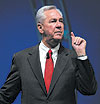 Allow
me to begin this keynote speech by adding my welcome to this beautiful
city by the Bay. I cannot begin to express my feelings at this time.
However, as some of you already know, Id better be careful or Ill
allow the emotions of the moment to run away with me.
Allow
me to begin this keynote speech by adding my welcome to this beautiful
city by the Bay. I cannot begin to express my feelings at this time.
However, as some of you already know, Id better be careful or Ill
allow the emotions of the moment to run away with me.